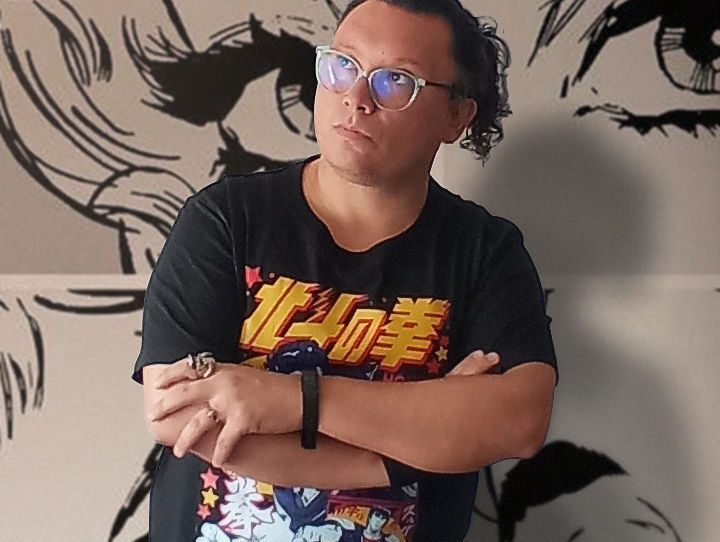

I’d like to share with you an interview I did with Richard Vasseur from the comics news site First Comics News. I’m both surprised and excited—this is the first interview I’ve ever done, and it gave me the chance to share a bit of my experience in the comic book world.
Here’s the link to the original interview:
https://www.firstcomicsnews.com/rich-interviews-seb-valencia/
RICH INTERVIEWS: Seb Valencia
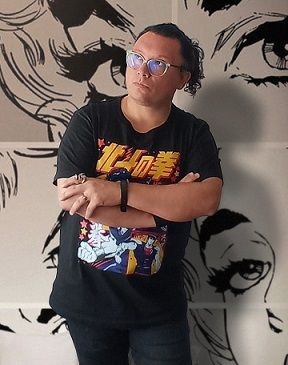
First Comics News: What first sparked your interest in comics?
Seb Valencia: I remember that as a child, probably under ten, I was curious like any kid and flipping through a stack of comics that weren’t mine. Suddenly, I saw something different—I don’t remember exactly if it was an issue of Heavy Metal or 1984, but it was impactful. I must have seen things that blew my mind, including content not suitable for children. After that, I started drawing a lot of sci-fi themes. The rest was just a matter of time, especially since I also watched a lot of TV—there were so many great shows during the ’80s and ’90s. I think my favorite characters back then were the Ninja Turtles. I used to draw them all over my school notebooks. There was inspiration everywhere, and I tried to draw everything that caught my attention: comics, cartoons, video games, and movies. As a teenager, I started saving money, and with what little I had, I bought comics. I clearly remember the first title I bought was The Weird #1, drawn by Bernie Wrightson. I copied many pages from that comic.
1st: How did you start your career in comics?
Seb: In my twenties, while studying design at university, I did a few collaborations for local publications. Even though I only wanted to draw, my drawing skills weren’t good enough yet, so I started by doing lettering. Even if I wasn’t drawing, my goal was to work in comics, so I was still happy to be part of the creative process. Not long after, more responsibilities came into my life—I became a father and a husband—so my priorities quickly changed, and I stepped away from comics for more than ten years. During all that time, I felt a pull, a desire to try again. It wasn’t easy; I was over 30 and very out of practice, so I had to train a lot, which pushed me to look for opportunities on internet forums. That’s how I got my first commissions—illustrations, character designs, color work. I accepted everything because I lacked confidence in my work and needed to improve fast. That’s how I met different writers and artists, some of whom I still work with today, like Pilot Studios, for example. They liked my color work and invited me to collaborate on many titles, doing colors and lettering. Several of those titles were published by Red 5 Comics. Thanks to those jobs, I was able to expand my portfolio and get commissions from other places, not just coloring, but also drawing.
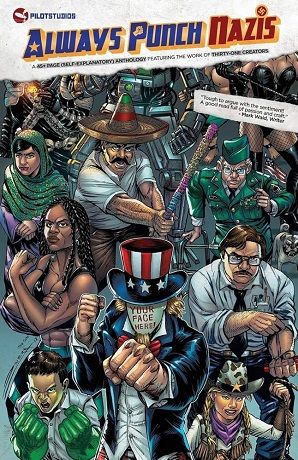
1st: You are the Colorist on “Always Punch Nazis” how do your colors make a page pop out at the reader?
Seb: I’m just one of many contributors. While I did work on several stories, it’s a collaborative effort involving many artists, each with their unique style. As a colorist, the first thing I do is understand each artist’s drawing style, so I can enhance the artwork through color, whether by using interesting palettes, separating planes with color, etc. Since no one draws the same, each style needs special treatment. The main goal is to make the page look striking and, most importantly, convey the right atmosphere. It also has to please the artist I’m working with.
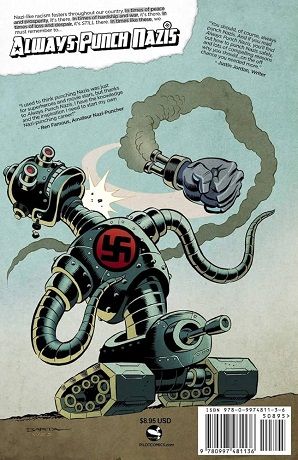
1st: What do you think of “Always Punch Nazis” as a whole?
Seb: It’s a total blast. It may seem like just a compilation of anti-Nazi stories, but I think it’s much more than that. We’ve seen a rise in racist and Nazi movements in various parts of the world—it’s not an isolated issue. Let’s be clear: Nazis have never been the good guys. I think the Pilot Studios team came up with this comic precisely because they were noticing these toxic movements in society, and a satirical comic was a great way to speak out against that kind of violence. What happened later with the Kickstarter controversy took everyone by surprise and made a huge impact, which just shows how relevant a comic book can be.
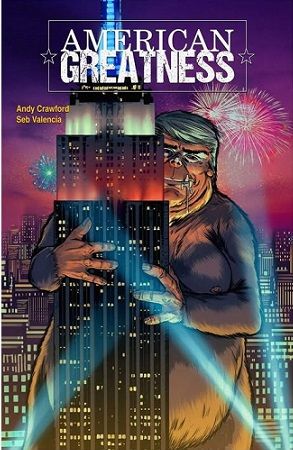
1st: What can you tell us about “American Greatness”? What is the storyline?
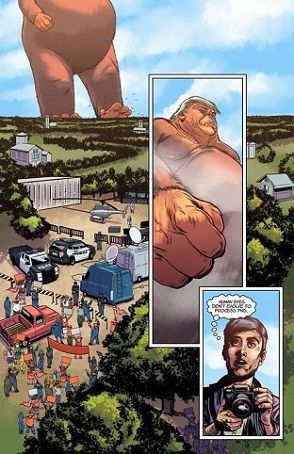
Seb: A mysterious, gigantic being named “Rumpke” suddenly appears in the heart of the U.S., and no one seems to know where he came from. That’s where Fred Millar, a journalist, comes in—he begins tracking the creature and collecting people’s opinions from every town the monster passes through. Conspiracy theories abound, and as Rumpke moves forward, he destroys something in his path. His impact is massive—just like him—and everyone has their theory about where he came from. As the story progresses, we unravel the mystery surrounding him while satirically reflecting on recent U.S. politics.
1st: What does Rumpke look like? Does this monster resemble any famous person?
Seb: You’ll likely notice a resemblance to someone in particular. If you spot it right away, I guess that means I’ve improved as an artist… funnily and grotesquely, at least. But I’d rather invite you to read the comic and draw your conclusions. I’ll just say this: his orange skin, wild hair, and constant grimaces are pretty telling.
1st: What is your mini-comic about on Linkin?
Seb: You could say it’s part of a social media campaign to showcase the features of Outbound Aerospace’s future aircraft. The company is developing prototypes for various aircraft that are meant to become the new standard in aviation in the coming decades. The CEO thought using the comic book language—especially emulating the Silver Age style—would be a great way to present this. Each mini-episode presents different features of the aircraft and the passenger experience. It’s been pretty challenging because everything happens inside a plane or an airport.
1st: Who is your favorite character to draw?
Seb: I’m not sure. Since I started working in comics, I’ve only drawn original characters created by independent authors—or myself—so I’ve lost track of well-known characters. I’ve drawn a few familiar ones in the past for sample pages and portfolio reviews. I did some samples for Predator, I think it was for Dark Horse before it became a Marvel property. I also did some pages for Valiant, where I took the liberty of combining Shadowman and Punk Mambo. I even drew a few Spawn characters for the Spawnuary event, but I never submitted them—I ended up doing a cover for Pilot instead, which I figured they’d appreciate more, and they did.
If I had the chance, I think I’d lean toward movie characters like Terminator, Alien, Predator, Robocop, or something like that. I used to enjoy the editions Dark Horse published with those characters. I’d also feel comfortable drawing Conan.
1st: Is lettering more than just adding words to a comic book?
Seb: Absolutely. It’s a design decision, and as such, lettering needs to have specific qualities to aid readability and add the final touches of personality and style. Font choice, balloon shapes, colors, sizes, and other details all quietly contribute to the final impact of a comic. Sometimes it gets overlooked because we focus more on the script or the art, but bad lettering can ruin a book.
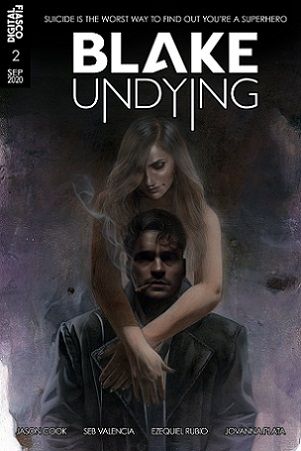
1st: In “Blake Undying # 2,” what characteristics did you give to the main character?
Seb: Issue #1 was drawn by Ezequiel Rubio, whose style is raw and visceral. To maintain the intensity of that dominant style, I focused on emphasizing the characters’ expressions to preserve the dramatic tone, especially for Blake in this episode. He goes through a lot of extreme situations, and his mood shifts are very evident in some graphic scenes. I used those contrasts to play with facial and body expressions without having to mimic Ezequiel’s linework.
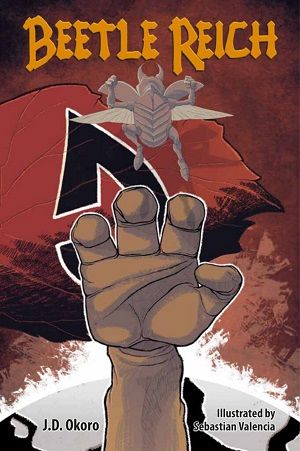
1st: Would you prefer to do more drawing over coloring, or lettering?
Seb: I prefer drawing, especially the concept and sketching stage. But finishing and inking can be pretty exhausting. On the other hand, coloring and lettering are faster processes, especially lettering, and work well for taking breaks between bigger projects without getting burned out. Even though I prefer one, I haven’t ruled out the others because each stage of creation has its perks. For example, coloring other artists’ work is very interesting—it helps you understand their techniques, processes, and styles.
1st: Did you have fun working as an Artist at Mythx Media on titles such as “Lady Lovecraft” and “Tales from the Cthulhuverse”?
Seb: Absolutely, that was a lot of fun. Part of the assignment was drawing sexy women and Lovecraftian monsters in a contemporary setting, which is very appealing for an artist looking for challenges. At the time, I wanted to draw horror content. My original sketches were revised several times because the female character designs were too thick and curvy, so we went through several versions until we landed on more stylized designs. It was a super enjoyable process, from character design to the actual pages.
1st: If you could have one super power, what would it be and why?
Seb: I think it’d be awesome to go back in time—but in the same body. Like a mental time travel, where only your consciousness goes back to a younger version of yourself, carrying the knowledge and wisdom of the present. I’d fix some things I didn’t know how to deal with back then.
1st: What would you like to say to those who pick up a comic you worked on?
Seb: Enjoy it. Have a good time.
I think comics are a kind of happy and safe place for many people, especially regular readers. But if a casual reader ends up having fun with it, then I think the goal was achieved, and they might even come back for more. So there’s no need to overthink it—just enjoy it.
If you found this interesting and want to know more about my work, I invite you to visit some of my galleries.